
The Art & Music of
Healing the Modern Soul

Chapter Illustrations
From the Book

1. What is Spiritual Awakening?

2. Foundations of a Spiritual Practice

3. Altars: Where Spirit Meets Form
4. The Sacred Breath: A Gateway to Presence


5. Core Practices of Spiritual Awakening

6. The Path of Inner Healing

7. Psychedelics: The Sacred Invitation
8. Honoring the Teachers


9. Preparing for a Psychedelic Journey

10. The Day of the Journey

11. Integration
12. The Science of Spiritual Practices
The Music Behind Healing the Modern Soul
Siempre, Mi Amor
(Always, My Love)

Or your favorite Streaming Music Platform, including Apple, YouTube, Amazon, Soundcloud
Encantando
(In the Spell of Your Song)

Or your favorite Streaming Music Platform, including Apple, YouTube, Amazon, Soundcloud
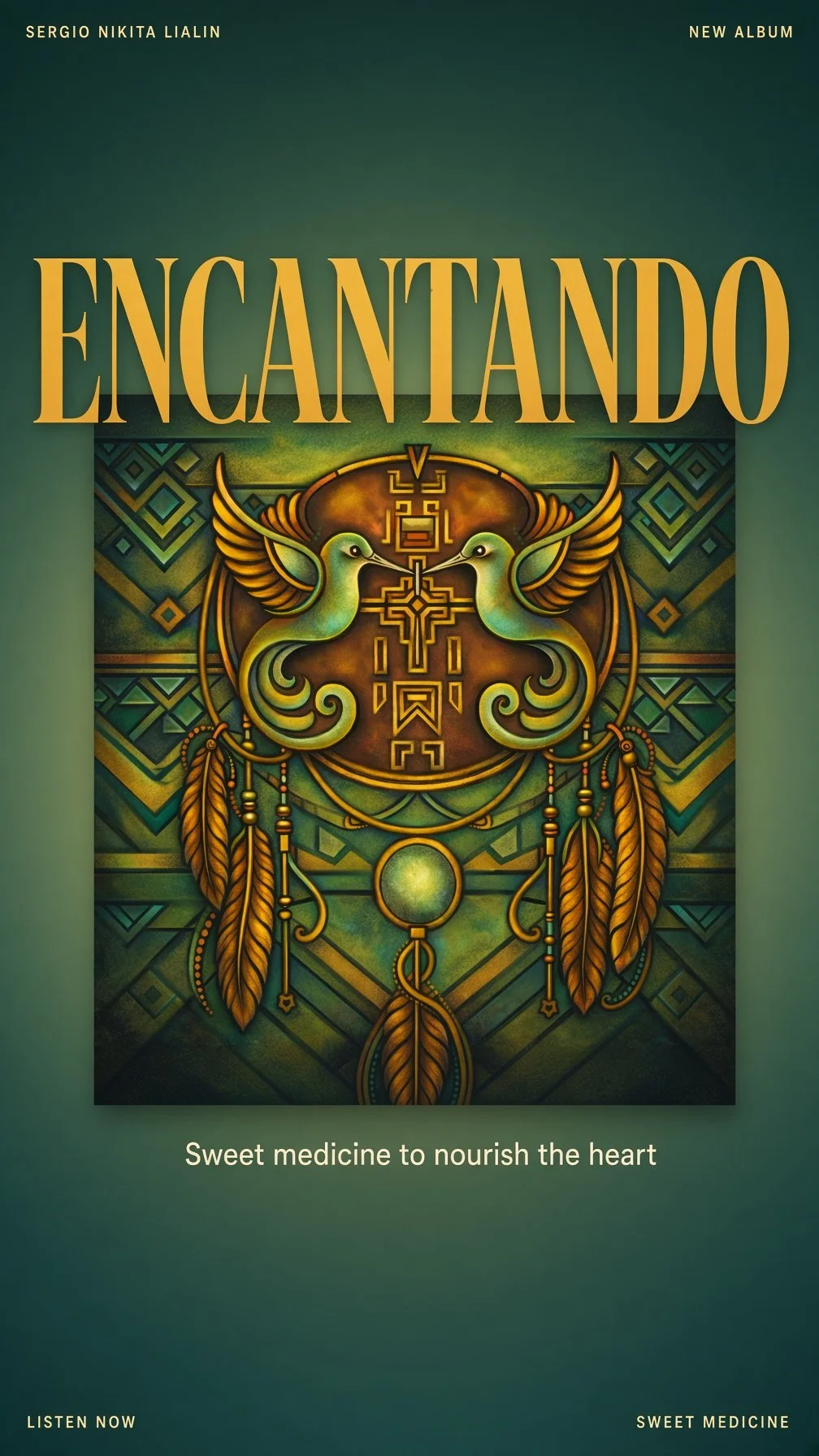
Eleven Songs, One Living Prayer
Encantando, the second album by Sergio Nikita Lialin
The stories, teachings, and moments of wonder behind the music.
A Love Letter
Words and music by Sergio Nikita Lialin
This song offers my love and tenderness through the language of wonder: dancing rain, turquoise thunder, moonlight, and a hummingbird carrying news of a healed heart. The natural world becomes my love letter with each image an offering to the beloved I await. The journey through the heavens comes to rest beside a warm fire, with a simple invitation to lie close and share the remaining hours of night.
Please Call Me By My True Names
Music by Sergio Nikita Lialin
Here I set the closing verses of Thích Nhất Hạnh’s poem “Please Call Me by My True Names” to music. His words hold joy and pain together, inviting me to hear both my cries and my laughter as expressions of this one, precious life. The song carries his prayer for awakening: that the door of the heart may remain open, allowing compassion to meet the world.
The Still Point
Words and music by Sergio Nikita Lialin
This song is a prayer that my/our thoughts, words, and actions might serve another human’s freedom and help the divine love within each of us open. The still point feels like a place of quiet presence from which the dance of life arises… a center we can return to even as life moves around us. At its heart is a simple blessing: you were born to be yourself. From that acceptance, love has room to unfold.
Hold the Line
Words and music by Sergio Nikita Lialin
This song is my respectful nod to the music that I grew up with and hold dear in my heart. It’s about staying faithful to love through uncertainty—keeping the heart open, giving thanks, and living with intention. Holding the line becomes a daily practice of patience and trust, with room to ask for help along the way. The closing refrain brings my prayer home: by grace, I remember that love is what I choose!
The Center of This Prayer
Words and music by Sergio Nikita Lialin
I wrote this song as an expression of gratitude and a blessing for life. It came through in a morning meditation in my hot tub.
It begins by thanking grandfather and grandmother for the songs and prayers that continue to live in our hearts and shine through the world around us. From there, the prayer widens to embrace all our relations—the creatures who walk, crawl, fly, and swim, the sacred circle, and this precious life we share.
The four directions, the sky above, and the earth below orient the prayer within a larger world. The wish to walk in beauty becomes a way of moving through life with care. Images of cleansing waters and ringing freedom bells carry the hope that healing can flow through us and outward into the world. It’s a standing prayer for this shift of the ages that we are in.
It closes with Lakota words, “Nitunkasila ahitonwan yankelo / Cekiya yo,” mean approximately, “Your Grandfather is sitting there, looking toward you. Pray to him.” They echo the Lakota Four Directions Song, where Grandfather is a sacred address for the divine. The final phrase, “Mitakuye Oyasin,” means “All my relations,” bringing the song’s blessings into an acknowledgment of our kinship with all life.
Eu Canto Nas Alturas
Composed by Raimundo Irineu Serra
“Eu Canto Nas Alturas” / “I Sing in the Highest”… comes from the Brazilian Santo Daime tradition. It is hymn number 40 in O Cruzeiro, the collection of hymns received by Raimundo Irineu Serra, known as Mestre Irineu, the founder of Santo Daime. Within this tradition, we hold the hymns as spiritual teachings received through inspiration.
The song expresses a joyful sense of belonging to God and the Divine Mother, whose presence appears as the full moon and a guiding star. It’s my reminder that our deepest wealth lies in love, sincerity, and the recognition of the sacred presence that accompanies us.
I first sang it in Brazil, where we often sang it around sunrise, emerging from deep meditation at the end of a long night of ceremony with Ayahuasca. It touched me so deeply that I began studying the Portuguese pronunciations, to sing the words with care. It became the first medicine song I learned to play and sing in Portuguese. Whenever I sing it, I remember those mornings… the returning light, us coming back from our deep slumber, our voices joining together, and the feeling of carrying something sacred from the night into a new day.
On Mane Padme Hum
Composed by Chandra Lancome
Music by Sergio Nikita Lialin
I first heard Chandra sing this song at Pacha Mama in Costa Rica, during a week of ayahuasca ceremonies. Its gentle, swaying 12/8 rhythm invites my body into prayer, while its imagery brings me into the meeting of complementary forces: sun and moon, sky and earth, masculine and feminine.
At the center is the jewel in the lotus. It’s my invitation to recognize the sacred within the unfolding of life—the luminous heart held within the flower, whose roots reach into mud as its petals open toward the light. Beauty emerges through our earthly experience, nourished by everything we’ve lived.
Jagube and rainha give this alchemy a living form. In the Santo Daime tradition, jagube is the ayahuasca vine, associated with the masculine principle; rainha, the “queen,” is the leaf, associated with the feminine. These two plants come together in the preparation of the sacrament, their union understood as a divine alchemy. The song honors that relationship: distinct gifts meeting to create something neither offers alone.
The invocation of Shiva and Shakti carries this theme into another spiritual language. Within the song, I hear them as the sacred dance through which life takes form. Sun and moon, vine and leaf, sky and earth become echoes of this intimacy, each revealing something through its relationship with the other.
For me, the song is a meditation on wholeness. It invites the masculine and feminine within me into conversation, allowing strength and tenderness, presence and movement, to nourish one another. I can feel the prayer for the many currents of our being to move together in love.
An Invitation
Music by Sergio Nikita Lialin
This song brings together fragments of poetry and my own words, woven into an invitation to wonder.
The first verse speaks of love as something vast, of which even our deepest experiences offer only a glimpse. I no longer remember the poem that inspired these lines, but the feeling has stayed with me: we can speak of what love has shown us while sensing how much remains beyond our words.
The chorus draws from William Blake’s “Auguries of Innocence,” inviting us to see a world in a grain of sand and heaven in a wildflower… to discover infinity and eternity within the small, ordinary things around us.
The second verse adapts a passage commonly attributed to Rumi, in which a seeker discovers, when the door finally opens, that he has been knocking from the inside. For me, this image holds the possibility that what we seek may already be closer than we imagine.
Together, these lines invite us to pause, look closely, and open ourselves to the wonder of being here.
Gracias, Con Amor
Words and music by Sergio Nikita Lialin
This song began with an Iriquois prayer that I found at the foot of an email from Ana Maria. It offered thanks to Mother Earth for sustaining us, to rivers and streams for water, to plants for medicine, to the moon and stars for light through the night, to the sun for its warmth, and to the Great Spirit for the goodness that guides and cares for all the children.
I wove the prayer into Spanish, allowing it to take shape as a song, then translated that Spanish version back into English for the second half. Traveling between languages became part of the composition: the gratitude found new words and rhythms while keeping its heart.
“Gracias, con amor” means “Thank you, with love.” That is the spirit of the song… a heartfelt acknowledgment of the earth, waters, plants, light, and sacred presence that sustain our lives.
Guided By Your Love
Words and music by Sergio Lialin
This song expresses my trust in the love that continues to guide me when I feel lost, when doubt casts its shadow, or when the familiar lights disappear. The recurring refrain celebrates the beauty of being loved and the reassurance of finding my way home through that connection. In the studio, I felt inspired to give it a reggae rhythm and simply ran with it, letting the song’s devotion move with warmth, ease, and joy.
Small Boats
Music by Sergio Lialin
I made this song from the closing lines of a poem by Robert Bly. They speak tenderly of the generosity that allows us to keep breathing, even when grief feels like it’s all we have to offer. The image of keeping our small boat afloat becomes a reason for forgiveness… a recognition of the effort it takes simply to continue through life’s storms.
I added the bridge “Vera, Nadezhda, Lubov” / “Faith, Hope, Love”… drawing on the three sisters honored in Russian Christian tradition. Nadezhda, also called Nadia, is my sister’s name. Weaving these words into the song was a way of bringing her into its prayer, placing hope beside faith and love as companions on the water.